

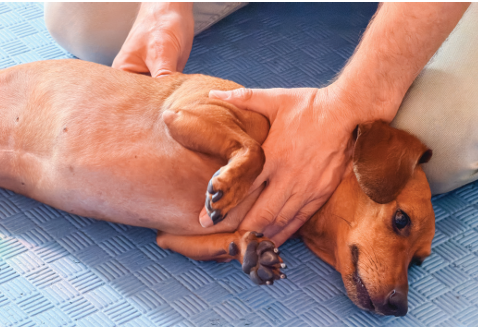
When your dog suddenly stops moving, hunches their back, cries out, or struggles to walk, you are instantly thrust into a high-stress medical crisis. Intervertebral Disc Disease (IVDD) is one of the most common and painful spinal conditions I treat, and I know how terrifying the prospect of sudden paralysis or high-cost surgery feels at that moment. But if you are facing an IVDD diagnosis today, please know you are not out of options
What Is IVDD?
The canine spine consists of bones (vertebrae) cushioned by rubbery, shock-absorbing intervertebral discs. IVDD occurs when these discs degenerate or rupture into the narrow spinal canal, compressing the spinal cord and nerve roots to cause intense pain, swelling, and nerve dysfunction.
Because the spinal cord functions like a central data cable, symptoms depend on the location and direction of the disc herniation:
Neck (Cervical): Affects all four limbs, causing severe neck pain, a low head posture, or a front-leg "root signature" limp.
Back (Thoracolumbar): Affects the hind limbs, causing an arched spine, abdominal tension, and weakness or paralysis in the back legs.
Asymmetric Compression: Disc material herniating off to one side makes that side significantly weaker or more painful.
Jumping off furniture, rough play, or normal daily movement can trigger an episode. While long-backed breeds are predisposed, IVDD can affect any dog (and occasionally cats) and quickly become an emergency.
What to Expect at the Vet
If you suspect IVDD, seek veterinary care immediately. Always handle a painful pet gently, as severe discomfort can cause even gentle animals to snap defensively.
As a veterinarian, I perform a detailed orthopedic and neurological exam to assess spinal compression depth:
Conscious Proprioception (CP): Turning the foot over onto the knuckles tests spatial awareness. Because these sensory nerve fibers run along the outermost surface of the spinal cord, CP deficits like knuckling or dragging toes are often the very first sign of compression.
Withdrawal Reflex: Pinching toe webbing tests a local spinal reflex arc, confirming localized nerve pathways are intact without measuring brain-processed pain.
Deep Pain Sensation: Innermost spinal cord fibers are tested via firm toe-bone pressure. A conscious reaction (turning the head or vocalizing) is required. Loss of deep pain signals critical, full-thickness damage and a grave emergency.
I often recommend baseline lab work, a 4Dx test, and X-rays to rule out fractures or tumors. However, definitive spinal cord imaging requires an MRI, typically performed under anesthesia by a veterinary neurologist.
Understanding Your Options: Surgical & Integrative Pathways
A consultation with a board-certified veterinary neurologist is the gold standard. An MRI provides a definitive diagnosis, and decompressive surgery offers the fastest route to relieving pressure with excellent outcomes.
Concurrent health conditions, multiple areas of compression, or financial constraints can make surgery unachievable. In our area, imaging and surgery can exceed $10,000 to $15,000. If you are facing these hurdles, please know you still have powerful, evidence-based alternatives. Euthanasia is not your only choice.
The Power of Integrative Medicine
Integrative medicine provides an active, evidence-based pathway to relieve pain, promote neural healing, and restore mobility, whether supporting a post-operative patient or serving as a non-surgical treatment plan.
Medical Acupuncture & Electroacupuncture (EAP): Acupuncture stimulates neurovascular points to trigger pain relief, drop tissue swelling, and relieve severe muscle spasms. EAP adds a low-frequency current to accelerate nerve healing and reduce cord edema.
The Research: Studies have shown acupuncture helps dogs recover walking ability significantly faster than standard medical management alone. Conservative care with acupuncture and strict rest boasts an 85–95% success rate for mild-to-moderate IVDD. Even in severe, long-standing cases (>48 hours duration), acupuncture achieved higher success rates for regaining mobility than delayed surgery alone.
Supportive Therapies: I combine acupuncture with laser therapy, PEMF (Assisi Loop), shockwave, TCVM herbs, and early, structured rehab to control pain, prevent muscle loss, and retrain gait mechanics safely.
Home Care, Incontinence, and Prevention
Recovery relies on dedicated daily management at home:
Strict Rest: Non-negotiable crate or small-pen rest for 6 to 8 weeks is critical to allow the disc to heal. Limit activity strictly to short, 5-to-10-minute bathroom breaks on a leash and harness.
Traction & Fall Prevention: Use non-slip floor runners or yoga mats on slippery floors, try Dr. Buzby's ToeGrips, pad stickers, or booties on the feet, and gate off stairs or dangerous areas in the home.
Support: A supportive harness (such as a Help 'Em Up Harness) allows you to safely assist with mobility without putting pressure on the abdomen or bladder.
Bladder & Fecal Management: Spinal compression can cause urinary or fecal incontinence. An unexpressed bladder risks infection or rupture, so I teach owners how to manually express the bladder until nerve function returns. Fecal passage is often passive during attempts to stand or lift; keeping pets clean and dry prevents skin irritation.
Prevention: Keep your dog lean, use furniture ramps, and walk with a body harness rather than a neck collar.
A Path Forward
An IVDD diagnosis can feel overwhelming, but it is not a hopeless situation. Whether your dog is recovering from spinal surgery, managing a mild flare-up, or navigating non-surgical paralysis, an integrative plan offers a realistic, compassionate path back to comfort and mobility. Reach out to us at Comfort Paws to discuss a recovery plan tailored to your pet.