

From Unlearning to Responding: Why Spring Triggers Reactive Responses
Last month, we explored why dog education requires unlearning the idea that obedience equals confidence and that control equals safety. Now we’re seeing why that matters.
As the weather shifts, I hear the same concern: “My dog was doing fine… and now they’re reacting to everything.” Pulling increases. Barking escalates. Walks feel tense instead of peaceful.
What many guardians describe as “reactivity” is more accurately an arousal-based response to environmental stimuli — a nervous system responding to a sudden increase in stimulation.
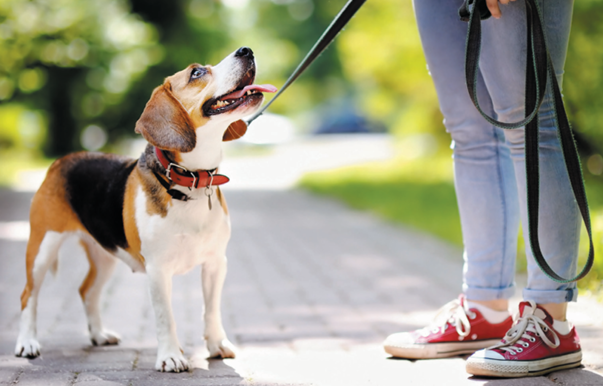
And spring increases stimulation everywhere. More scent. More movement. More dogs. More people. More sound. Picture this: You step outside on a warm afternoon. Your dog leans forward before you reach the sidewalk. The leash tightens. Their breathing becomes shallow. Their ears fix. Their eyes lock onto a dog across the street.
The bark hasn’t happened yet. But the response has already begun. The reactive response doesn’t start with the outburst. It starts with the forward lean. The tension in the leash. The fixed stare.
This is where I introduce the traffic light framework:
-Green: regulated, curious, responsive.
-Yellow: arousal rising tension, scanning, shallow breath.
-Red: the nervous system tips into a reactive response.
Most people wait until red. But confidence is built in green. And supported in yellow.
We have been conditioned to intervene at red to correct, command, or control. But red is not where learning thrives. Red is survival. Yellow is where influence lives.
So what do you do in yellow?
You manage the environment — not the dog. That might mean creating distance early. Crossing the street before tension rises. Slowing your pace instead of tightening the leash. Turning away and resetting before escalation.
Support does not mean correcting the signal. It means reducing load. Volume matters. Cars are loud. People are loud. Spring is loud visually, socially, and through scent.
When sound, sight, and smell overlap, the nervous system absorbs that input. And when the volume is too high for too long, regulation decreases.
Dogs don’t need the world removed. They need the world to whisper.
Sometimes that means choosing quieter routes. Sometimes it means shorter outings. Sometimes it means letting your dog decompress in the woods behind your house instead of navigating a busy sidewalk.
You are not avoiding life. You are regulating input. Regulation is not a personality trait. It is a capacity built through repeated experiences of safety. And capacity grows when we respond earlier, not louder.
Spring doesn’t create behavior problems. It amplifies sensory volume.
When we help dogs return to green again and again, we build resilience. And resilience is what confidence is made of.
Behavior isn’t the enemy. It’s the invitation.